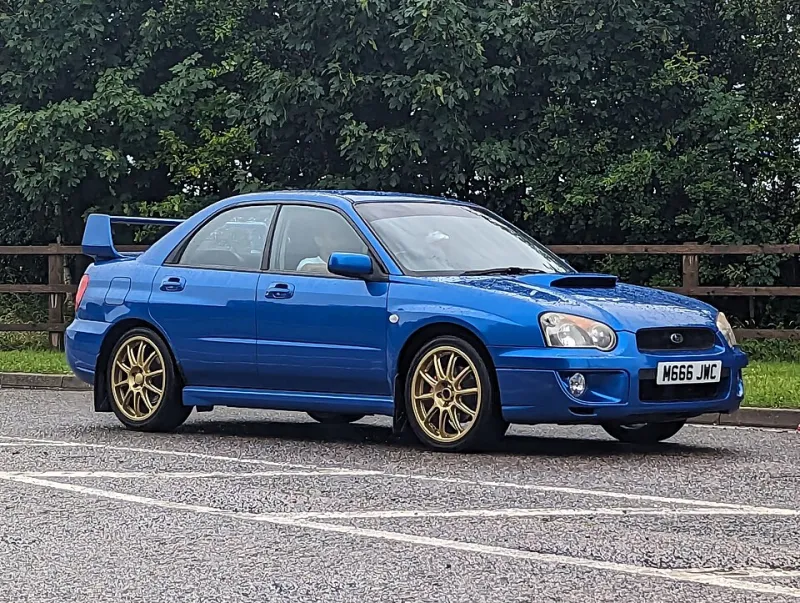
Modified and Paying For It: How Telling Your Insurer About Your WRX Build Can Cost You More Than the Mods Did
Photo: Q4398124, Goznak (Q2133605), Public domain, via Wikimedia Commons
You saved up, did the research, pulled the trigger on a tune, an upgraded intercooler, and a set of coilovers. The car feels incredible. Then renewal season rolls around, you mention the mods to your insurer, and suddenly you're staring at a quote that makes your credit card statement look reasonable by comparison.
Welcome to what the WRX community has quietly started calling the Subaru Tax — the premium penalty that follows enthusiasts who are honest about their builds. It's frustrating, it's real, and it's more complicated than most owners realize. So let's break it down.
Why Insurers Even Care What's Under Your Hood
Insurance companies are in the business of calculating risk, and modifications — especially performance-related ones — shift the math in ways that make underwriters nervous. A stock WRX is already rated as a higher-risk vehicle compared to, say, a base Impreza. Add a tune, a cold air intake, and sticky summer tires, and you've given the actuary a reason to bump your rate.
The reasoning isn't entirely without merit. A tuned car is theoretically capable of higher speeds. Aftermarket suspension changes handling dynamics. Custom exhaust setups can affect emissions compliance in some states. None of that automatically makes you a dangerous driver, but insurers don't price policies based on individual behavior — they price them based on statistical categories.
The WRX already sits in a category that attracts younger, more aggressive drivers on average. Mods push that profile further in a direction that costs you money at renewal.
What You're Actually Required to Disclose
Here's where things get legally interesting, and where a lot of enthusiasts make mistakes in both directions — either disclosing too little or panicking and disclosing way too much.
In the US, disclosure requirements vary by state and by insurer, but the baseline rule is this: you are required to disclose modifications that materially affect the risk the insurer is taking on. That language — "materially affect" — is doing a lot of work.
A tune that adds 50 horsepower to a turbocharged vehicle? That likely qualifies. A short throw shifter? Probably not. Cosmetic mods like a lip spoiler or tinted windows? Almost certainly irrelevant to your liability coverage. Upgraded brake pads that actually improve stopping performance? Arguably they reduce risk, though good luck getting credit for that.
The practical problem is that most standard auto insurance applications ask a simple yes/no question about modifications, which forces nuance into a checkbox. If you check "yes," you open a conversation. If you check "no" and something happens, you've potentially given the insurer grounds to deny your claim.
That's the real danger — not the premium increase, but the coverage gap.
The Claim Denial Scenario Nobody Wants to Think About
Let's say you didn't disclose your tune. You get into an accident — not your fault, the other driver ran a red light. Your car is totaled. The insurer sends an adjuster, they notice the aftermarket intake, pull a ECU report during the investigation, and discover the vehicle was tuned.
At that point, depending on your state and your specific policy language, the insurer may have grounds to deny the claim, reduce the payout, or in worst-case scenarios, rescind the policy entirely on the basis of material misrepresentation.
This isn't a hypothetical designed to scare you. It's a scenario that has played out for WRX owners in forums across the country. The mod that seemed too minor to mention becomes the reason you're fighting your insurer instead of getting your car fixed.
Strategies That Actually Help Keep Premiums Reasonable
The good news is that disclosure doesn't have to mean financial pain — if you approach it strategically.
Shop with specialty insurers. Companies like Hagerty, American Collectors, and Grundy exist specifically for modified and enthusiast vehicles. Their underwriters understand what a stage 2 tune means and price accordingly — which often ends up cheaper than a standard insurer applying a blanket "modified vehicle" surcharge. They're not always the right fit for a daily driver, but they're worth a quote.
Look into agreed value policies. Standard policies pay actual cash value, which depreciates and rarely accounts for the money you've put into aftermarket parts. An agreed value policy locks in a number you and the insurer settle on upfront. For a well-built WRX, this can actually work in your favor.
Document everything. Receipts, installation photos, dyno sheets — keep a file. If you ever need to make a claim involving aftermarket parts, documentation is the difference between getting reimbursed for your upgraded parts and getting paid for stock components.
Ask specifically about performance modification endorsements. Some mainstream insurers offer add-on coverage for aftermarket parts, usually up to a set dollar limit. It won't cover a full Stage 2 build, but it can cover a significant portion of bolt-on work without triggering a full policy reclassification.
Be precise in what you disclose. You're not required to volunteer a parts list unprompted. Answer the questions asked, accurately and completely. If the application asks whether the vehicle has been modified for performance and it has, say yes — but you don't need to itemize every mod if they're not asking for that level of detail. If they want more information, they'll ask.
The Honest Math
For most WRX owners running a moderate build — a tune, intake, exhaust, maybe coilovers — the premium increase after proper disclosure typically lands somewhere between $200 and $600 per year depending on your location, driving record, and insurer. That stings, but it's manageable.
What's not manageable is a denied claim on a totaled car because you saved $400 a year by not disclosing a $1,500 tune. The math on that trade-off is brutal.
The WRX community has always been built on the idea that this platform rewards people who do things the right way — who understand what's happening under the hood, who put in the work, who don't cut corners. That same philosophy applies to how you handle the paperwork side of owning a modified car.
Find an insurer who understands what you've built. Disclose accurately. Document thoroughly. The Subaru Tax is real, but it's a lot more manageable when you know the rules of the game.