Your Stock Wastegate Spring Is Smarter Than You Think — Stop Trying to Replace It

If you've spent any time in WRX communities — whether that's forums, Discord servers, or just hanging around at a Cars and Coffee — you've heard the pitch. "The stock wastegate is the first thing that needs to go." It gets said with the kind of confidence that implies the factory engineers just phoned it in, and that some $200 aftermarket controller is going to unlock what Subaru left on the table.
Except when you actually look at the data, that story falls apart pretty quickly.
What the Factory Wastegate Is Actually Doing
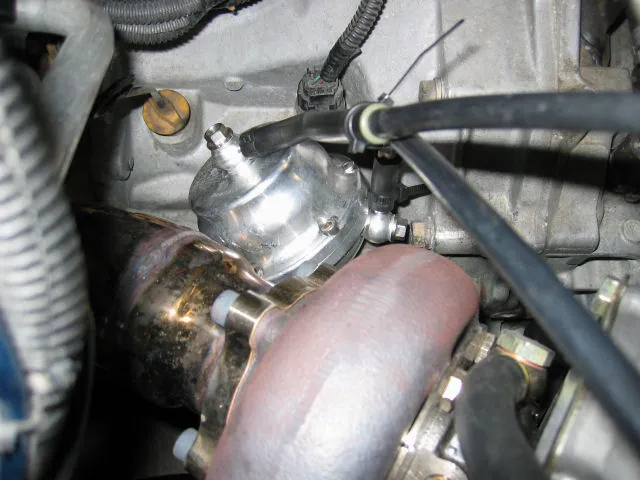
Let's start with the basics. The wastegate's job is to regulate how much exhaust gas bypasses the turbine wheel, which controls turbine speed, which controls boost pressure. Simple enough. What's less obvious is how much engineering goes into calibrating the spring rate and the pneumatic bleed circuit to achieve a specific boost curve — not just a peak number, but the entire shape of how boost builds and holds across the RPM range.
Subaru's WRX-spec wastegate springs aren't selected based on what's cheapest or easiest to source. They're matched to the specific turbine housing A/R ratio, the compressor map of the IHI turbocharger, the intercooler volume, and the ECU's boost control strategy. The spring preload determines where the wastegate starts cracking open, and the bleed circuit — the small solenoid that modulates actuator pressure — handles everything above that baseline.
That bleed system is doing more work than most owners realize. The factory ECU is cycling that solenoid at a high duty cycle, using closed-loop boost feedback to maintain target pressure with remarkable precision. It's not a dumb on/off system. It's actively compensating for atmospheric pressure changes, intake air temperature, and engine load in real time.
Where the "Upgrade" Logic Goes Wrong
The argument for aftermarket boost controllers usually goes something like this: the factory system is conservative, it's leaving boost on the table, and a manual or electronic controller will let you run more pressure more consistently. And on the surface, that sounds reasonable.
The problem is that "more consistent" and "better" aren't the same thing. The factory boost curve has a slight taper built in at the top of the RPM range. That taper isn't timidity — it's protecting the engine from running into compressor surge territory and managing exhaust gas temperatures at high load. When you flatten that curve with a stiffer spring or an aftermarket controller set to hold peak boost all the way to redline, you're not just adding power. You're removing a safety margin that was put there for a reason.
Pressure logs from WRXs running stock boost control versus common aftermarket manual boost controllers tell an interesting story. The stock system, even on a light tune, tends to show very stable, smooth pressure traces with minimal overshoot. Many manual controllers, particularly on cars without a matching ECU tune, show boost spikes — sometimes 2-3 PSI above target — before settling. Those spikes are brief, but they're real, and on an engine running close to its knock threshold, they matter.
The Boost Creep Misunderstanding
A lot of owners confuse boost creep with wastegate failure or spring weakness, and that confusion drives a lot of unnecessary parts replacement. True boost creep — where boost pressure continues climbing past target at high RPM — is almost always an exhaust housing flow issue, not a spring rate issue. When the turbine housing flows more exhaust gas than the wastegate can bypass, pressure builds regardless of what the spring is doing.
If your WRX is showing creep on a stock or mildly modified setup, swapping the wastegate spring for a stiffer unit isn't going to fix it. You've changed the opening threshold without addressing the underlying flow mismatch. The result is often a car that builds boost more aggressively at low RPM — which can actually increase knock risk — while still creeping at the top end.
The actual fix for boost creep, when it genuinely exists, is usually a turbine housing with a larger wastegate port, or a turbo upgrade that moves the operating point on the compressor map. Not a spring swap.
What the Data Actually Supports
Tuners who work with WRXs regularly — the ones pulling actual datalogs rather than going by feel — will generally tell you the same thing: on a stock or mildly modified WRX running a quality ECU tune, the factory wastegate system is not the limiting factor. It's capable of holding boost targets accurately, it responds quickly to the ECU's commands, and it doesn't introduce the kind of overshoot or instability that requires an aftermarket solution.
The cases where aftermarket boost control hardware genuinely earns its place are on heavily modified cars — think big turbo swaps, ported heads, and built motors — where the original system's calibration is completely out of range for the new operating conditions. At that point, you're not upgrading the factory system; you're replacing it because the factory system was never designed for that application.
Before You Order Anything
If you're chasing more boost on your WRX, the most productive thing you can do is get a proper tune from a tuner who works with actual datalogs, not just a generic off-the-shelf map. A good tune will extract what the factory system is capable of delivering safely, and in most cases, that's more than enough for a street-driven or lightly tracked WRX.
The factory wastegate isn't holding you back. It's doing exactly what it was designed to do — and it's doing it pretty well.