Stock Plenum, Secret Weapon: The Truth About Your WRX Intake Manifold Nobody Wants to Admit
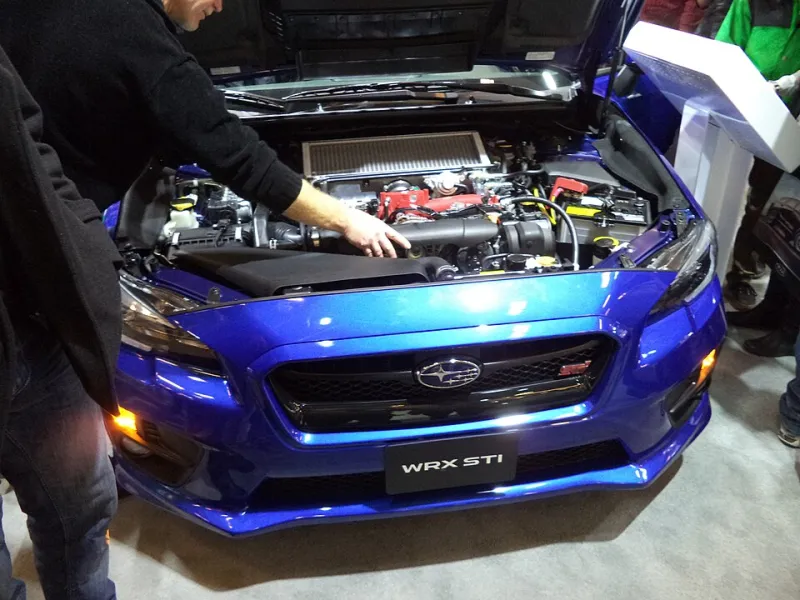
Photo: Zytonits, CC BY-SA 2.0, via Wikimedia Commons
Every WRX owner hits a point in their build where they start staring at the intake manifold like it owes them something. It's sitting right there, looking factory, looking boring, looking like the one thing standing between you and another 30 horsepower. The forums will back you up. Someone's always got a dyno sheet. And the aftermarket options are genuinely tempting.
But here's the thing — Subaru's engineers weren't idiots. That stock plenum is doing a lot of things at once, and some of those things are actively keeping your engine alive and your tune stable. Before you pull the trigger on an aftermarket manifold, it's worth understanding exactly what you're working with, what you're giving up, and whether the gains are real or just optimistic math on someone else's build.
What Subaru Actually Built Into That Manifold
The factory intake manifold on the EJ and FA-series WRX platforms isn't just a hollow box that moves air. It's a carefully tuned component designed around specific runner lengths, plenum volume, and resonance frequencies that complement the engine's torque curve in a very deliberate way.
Subaru sized the stock plenum to support the power range the engine was calibrated to produce at the factory — which, on a stock or mildly modified WRX, is actually a pretty wide, drivable powerband. The runner geometry helps create a pressure wave effect at mid-range RPMs that boosts cylinder filling without relying entirely on turbo boost pressure. That's not an accident. That's engineering.
On top of that, the stock manifold integrates cleanly with the factory fuel rail, injector bungs, and on some model years, the tumble generator valves (TGVs) that help with cold starts and emissions compliance. It's a system, not just a part.
Where the Stock Unit Actually Becomes a Bottleneck
None of that means the factory manifold is perfect for a modified car. It isn't.
Once you start pushing significantly beyond stock power levels — we're talking serious turbo upgrades, high-flow injectors, aggressive fueling targets — the stock plenum's volume and runner sizing can become genuinely limiting. At high RPM under heavy boost, the stock design can create airflow turbulence and distribution imbalances across the cylinders. That means cylinders aren't all seeing the same charge density, which makes consistent, safe tuning harder.
On the EJ platform specifically, owners running big turbos pushing north of 350-400 wheel horsepower often find the stock manifold starts to show its ceiling. The factory runners are relatively short and tuned for a narrower boost window than a built motor with an upgraded turbo operates in. At that level, a well-designed aftermarket manifold with larger plenum volume and optimized runner length can genuinely improve top-end power and make the tune more consistent.
But — and this is a big but — "can improve" is doing a lot of work in that sentence.
The Gains Most People Won't Actually See
Here's where things get honest. The majority of WRX owners running bolt-on modifications — intake, exhaust, intercooler, maybe a port tune or Accessport map — will not see meaningful, measurable power gains from swapping the intake manifold. Full stop.
The stock plenum isn't the restriction in a Stage 1 or Stage 2 build. Your turbo, your fueling, your intercooler efficiency, and your tune are all working within a range where the factory manifold is not the limiting factor. Spending $600 to $1,200 on an aftermarket manifold at that build level is essentially buying a part that looks different on your engine bay photos.
Worse, some owners report drivability issues after the swap — rough idle, stumbling at part throttle, uneven fueling — because the aftermarket manifold changed the fuel rail geometry or injector positioning enough to require a complete retune. If your tuner didn't account for the manifold change specifically, you might actually be running worse than before.
The TGV Problem Nobody Mentions at the Parts Counter
If you're on a 2008-2014 WRX with the EJ257, you need to have a specific conversation about tumble generator valves before you touch the intake manifold. The TGVs live in the factory manifold, and they're connected to sensors that your ECU actively monitors.
Some aftermarket manifolds delete the TGVs entirely, which sounds like a good idea until your ECU starts throwing codes and going into limp mode because it's no longer reading the signals it expects. Others include provisions for the TGVs but require you to either relocate the sensors or delete them in the tune. Either way, this isn't a bolt-on situation — it's a system modification that requires your tuner to be specifically aware of the change.
Skip that conversation and you're looking at idle issues, cold-start problems, and potentially a car that runs great at wide-open throttle but feels terrible everywhere else. That's not a trade most daily drivers want to make.
When the Upgrade Actually Makes Sense
So when should you actually consider an aftermarket intake manifold? A few scenarios make legitimate sense:
You're running a built motor with a big turbo. If you're at Stage 3 or beyond, pushing serious power with upgraded internals and a turbo that's significantly larger than stock, the manifold upgrade is part of a larger system change that your tuner should be recommending anyway.
Your tuner specifically identifies it as a restriction. A good datalog review can show cylinder-to-cylinder fueling variation that points to manifold-related distribution issues. If your tuner pulls the data and points at the manifold, that's a legitimate reason to upgrade.
You're building for track use and top-end power is the priority. Some aftermarket manifolds sacrifice mid-range torque for top-end flow, which is a trade that makes sense on a dedicated track car but is miserable on a car you commute in.
Outside of those scenarios, the stock manifold is probably serving you better than you think.
The Bottom Line on That Factory Plenum
The WRX intake manifold is one of those parts that looks like low-hanging fruit but rarely delivers the gains people expect unless the rest of the build has genuinely outgrown it. Subaru put real engineering into that component, and at most build levels, it's not what's holding you back.
If you're serious about understanding where your actual power ceiling is, get a proper tune and review the datalogs with someone who knows the platform. Nine times out of ten, the manifold won't be the conversation. And if it is — if you're genuinely at the level where the factory plenum is a restriction — then you already know it, because everything else in your build has already been sorted.
Until then, that boring-looking stock unit is doing more for your engine than you're giving it credit for.