Hidden Cracks, Big Consequences: What's Really Happening to Your WRX's Subframe
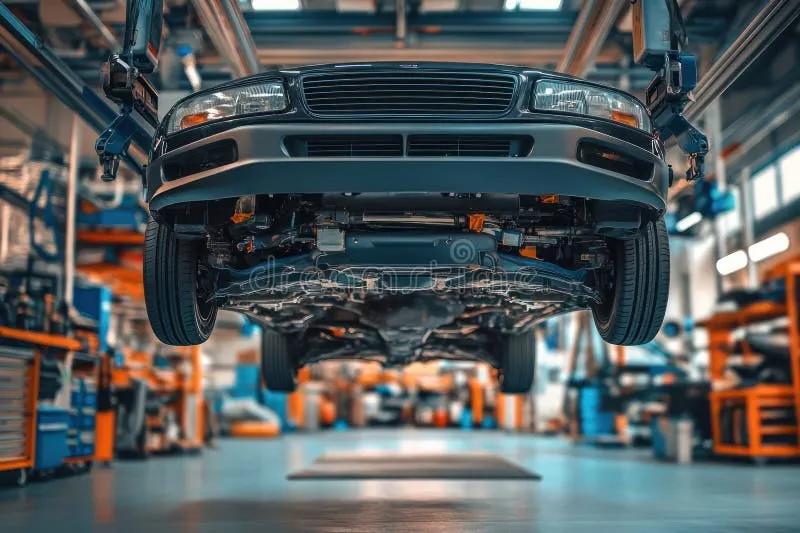
Photo: car subframe undercarriage inspection repair garage lift, via thumbs.dreamstime.com
Let's be honest — when most WRX owners start chasing performance, they're thinking about boost pressure, injector sizing, or which set of wheels to run. The chassis itself? That tends to be an afterthought. It's just... there. It holds everything together. It's not going anywhere.
Except sometimes it is. Literally.
Subframe cracking on the WRX is one of those issues that doesn't get nearly enough airtime in enthusiast circles, partly because it's not flashy, and partly because by the time you notice it, you've already got a problem that's well past the "ignore it and see" stage. If you're putting real miles on your car — especially spirited ones — this is worth understanding from the ground up.
What Is the Subframe, and Why Does It Matter?
The subframe (sometimes called the rear subframe or cradle depending on which end you're talking about) is essentially the structural backbone that mounts your suspension components, differential, and drivetrain to the main chassis. On a WRX, it's doing a lot of work. The symmetrical all-wheel-drive system runs through it, your rear control arms bolt to it, and every pothole, autocross run, or canyon road you've ever attacked has transferred force directly through it.
When that subframe develops cracks — typically at the mounting points or along the frame rails near high-stress areas — you're not just dealing with a cosmetic issue. You're dealing with compromised suspension geometry, unpredictable handling, and in serious cases, a car that's genuinely unsafe to drive at speed.
Which Generations Are Most at Risk?
The short answer is that no WRX generation gets a completely clean bill of health here, but the 2008–2014 chassis has historically drawn the most complaints, particularly around the rear subframe mounting points and the areas where the front subframe attaches to the unibody. The 2015–2021 VA-generation cars have also shown vulnerabilities, especially in the front subframe region near the engine cradle, with cracking often appearing around the front differential mount area.
Owners running coilovers — particularly stiffer setups with high spring rates — tend to accelerate the problem. That's not an argument against coilovers, but it is an argument for understanding what you're asking your chassis to handle when you stiffen up the suspension significantly.
High-mileage cars that spent time in rust-belt states like Ohio, Michigan, or New York are in a particularly rough spot. Salt corrosion weakens the metal, and structural fatigue sets in faster when the base material is already compromised. If you bought a used WRX from the Midwest or Northeast without a thorough inspection, this is one of the first things you should be looking at.
Why Does It Happen?
The root causes are a mix of design reality and how the car gets used.
First, the WRX was engineered as a performance-oriented platform, but Subaru's production tolerances and material choices have always reflected the reality that this is a mass-market car with a mass-market price point. The subframe isn't built like a dedicated track car's chassis — it's built to be good enough for the performance it's rated for under normal use.
"Normal use" is doing a lot of lifting in that sentence.
When you add suspension modifications, run lower-profile tires on rougher roads, or spend weekends at autocross events, the cumulative stress load on the subframe mounts increases significantly. The chassis flexes under hard cornering and acceleration, and over time, that flex concentrates at the weakest points — usually weld seams and mounting holes — until micro-cracks form and eventually propagate.
Poor-quality aftermarket parts can make this worse. Solid polyurethane bushings, for example, reduce compliance to the point where impact forces that would normally be absorbed by the bushing material get transferred directly into the chassis structure instead. That's not always a bad tradeoff, but it's one you should make with open eyes.
Early Warning Signs You Shouldn't Ignore
The frustrating thing about subframe cracking is that the early signs are easy to dismiss as something else entirely.
Clunking or knocking from the rear (or front) suspension — especially over bumps, during acceleration, or when the car transitions from braking to throttle — is one of the first things owners report. It's the kind of noise that gets blamed on worn sway bar end links or tired control arm bushings, because those are more common and cheaper fixes. Don't let that assumption cost you.
Handling that feels vague or inconsistent is another one. If your WRX suddenly doesn't feel as planted as it used to, or if the rear end behaves differently than expected in sweeping corners, that's worth investigating. Alignment specs that keep drifting even after fresh adjustments can also point to subframe movement.
Visible cracking or stress marks around subframe mounting points are obviously the clearest indicator, but you'll only catch those with a proper inspection. Get the car on a lift and use a flashlight. Look at the weld points, the mounting holes, and the areas where the subframe contacts the unibody. Any rust staining coming from a specific point — not general surface rust, but localized streaking — deserves a closer look.
What You Can Do About It
If you're still in the prevention phase, a few upgrades make a meaningful difference.
Subframe reinforcement plates are one of the most cost-effective structural upgrades available for the WRX. Companies like Cusco, Perrin, and a handful of smaller fabricators produce plates that bolt to the subframe mounting areas and distribute load across a wider surface area, reducing the stress concentration at any single point. Installation is usually straightforward and doesn't require anything exotic in terms of tools or expertise.
Upgraded suspension bushings deserve a nuanced take. Softer durometer polyurethane or even quality OEM-spec rubber replacements can actually help by restoring compliance that worn bushings have lost, without going full-rigid and hammering your chassis. If you're on a track-oriented build and running solid bushings, at least be consistent about inspecting your subframe more frequently.
Regular inspections are honestly the most underrated preventative measure. Twice a year — or after any significant event like hitting a curb, a bad pothole, or a track day — get the car up on a lift and actually look at the structure. Catching a crack when it's two inches long is a manageable weld repair. Catching it when it's traveled across a mounting point is a much bigger conversation.
If you've already found cracking, the fix depends on severity. Minor cracks at non-critical points can sometimes be professionally welded and reinforced. Significant structural damage, particularly around primary mounting locations, may warrant subframe replacement. Don't try to drive through it hoping it stabilizes — it won't.
The Resale Reality
Here's the part nobody wants to think about: a WRX with documented subframe issues is a tough sell. Even with repairs, buyers — especially informed enthusiast buyers who know what to look for — will discount aggressively or walk away. Staying ahead of this problem isn't just about keeping your car safe to drive. It's about protecting the investment you've made in the build.
The WRX is a legitimately capable platform. But capability has a cost, and part of that cost is understanding where the factory left some structural margin on the table. Now you know where to look.